Showing posts with label PTC 6. Show all posts

Friday, March 24, 2017

Week 15 - Gamification

Gamification
Gamification is a concept, which is not exclusive of education. Some researchers generically defined it as “the use of game design elements and game mechanics in non-game contexts” This broad definition has been further refined to reflect the most common objective of gamification: increase user experience and engagement with a system. It is important to note that Games and Gamification are two different things! (Deterding, Dixon, Khaled & Nacke, 2011).
Gamified Services
Huotari & Hamari (2011) outline some ways in which services have been gamified

Core serviceEnhancing serviceGamified service
  • LinkedInprofile
  • Progress bar measuring progress in filling personal details
  • The enhancing service increases the perceived value of filling all details by invoking progress-related psychological biases.
  • Cafe
  • Mayorship competition in Foursquare  
  • The enhancing service creates a competition between customers where they have to visit the cafe frequently enough → competition
  • Dry cleaner
  • Loyalty stamp card - 1 stamp for every visit
  • The enhancing service invokes the psychological biases related to progress and thus increases the perceived value of using the same dry cleaner service.
  • Gym
  • Heya Heya
  • Gym experience that sets goals and help to monitor the progress of the training.

Game mechanics
In his video (on the portal) Seth Priebatsch described the four game mechanics of appointment, influence and status, progression and communal discovery. Badgeville (n.d.) outline a large number of game mechanics:

  • Achievements 
  • Appointments 
  • Behavioral Momentum 
  • Blissful Productivity 
  • Bonuses 
  • Cascading Information Theory 
  • Combos 
  • Community Collaboration  
  • Countdown 
  • Discovery 
  • Epic Meaning 
  • Free Lunch 
  • Infinite Gameplay         
  • Levels 
  • Loss Aversion 
  • Lottery  
  • Ownership 
  • Points 
  • Progression 
  • Quests 
  • Reward Schedules         
  • Status 
  • Urgent Optimism 
  • Virality 


Professional leadership games
Gamification has been applied to leadership in some organisations One example is the NTT Data Ignite Leadership Game that addresses five key skills for leaders
negotiation
communication
time management
change management
problem solving


Deloitte's Leadership Learning Motivator includes sharing badges on professional networks such as LinkedIn and Twitter. Meister (2013) provides some more detail on both games, while Bodnar (2014) explores some of the key concepts in more depth, including some discussion around whether the same motivational game mechanics work across cultures.
Seven principles of game-based design
These principles are outlined on the Quest to Learn website (Quest To Learn, n.d.)
Everyone is a participant
Challenge
Learning happens by doing
Feedback is immediate and ongoing
Failure is reframed as “iteration”
Everything is interconnected
It kind of feels like play


Game thinking
Marczewski (2016) explores the following types of game thinking:
Game inspired design: This is where no actual elements from games are used, just ideas such as user interfaces that mimic those from games, design or artwork that is inspired by games or the way things are written.
Gamification: Extrinsic gamification is the sort that most people are used to, where game elements are added to a system. Things like points, badges, progress bars etc.Intrinsic gamification is more about using motivation and behavioural design to engage users.
Serious games: These may be teaching/learning games that teach you something using real gameplay, simulators that provide a virtual version of something from the real world that allows safe practice and testing, meaningful games that use gameplay to promote a meaningful message to the player, or purposeful games that create direct real world outcomes.
Play (games / toys): Play is free form and has no extrinsically imposed goals. It is done for fun or joy. Games add defined goals and rules to play (such as challenges). Toys are objects that can be used in play or games.
Some examples of serious games
Sparx (https://www.youtube.com/watch?v=9pfzCKt0FyA )
Quest2teach (http://quest2teach.strikingly.com/ ).
Tinnitus game (http://www.uniservices.co.nz/Portals/0/All%20One%20Pagers/Tinnitus_game.pdf)
Cancer Research UK's game Play to Cure: Genes in Space (http://scienceblog.cancerresearchuk.org/2014/02/04/download-our-revolutionary-mobile-game-to-help-speed-up-cancer-research/)
Educational game model
According to Amory (2007), Educational computer games should:
Be relevant, explorative, emotive and engaging
Include complex challenges, puzzles or quests
Be gender-inclusive and non-confrontational
Provide appropriate role models
Develop democracy and social capital through dialogue
Support authentic learning activities
Support the construction of tacit knowledge


Educational games need all the usual qualities of games, plus they should not contain any socially undesirable features (racism. sexism, violence, etc) but provide positive models, plus they have to have some embedded pedagogy. Maybe this explains why successful educational games are so hard to create.
Kupu Hono
You can try out a basic demo of Tyne Crow’s Kupu Hono Maori language learning game at www.kupuhono.co.nz
This is an example of a learning game designed for mobile devices that uses a virtual game world.
Flow theory
Flow experience is widely accepted to be one of the fundamental reasons that people play games. It is the essence of games. For game designers, the question is not whether flow is important, but, rather, how long you can keep your players in flow (Murphy, 2011).
Game creation tools
One of the tools that could be used with students to create their own games is Gamefroot. There is a video in the portal about how one teacher used Gamefroot for assessment.
Mobile Learning Tools
A number of tools have been developed for mobile devices that support game-like learning experiences linked to exploring outdoor environments. They include such features as competing individuals / teams, ‘treasure hunt’ style activities, scores/ badges for achievement and leader boards. Some examples of this type of tool include:
Seppo
Wikitude
ARIS
ActionBound
Layar 


Saturday, November 19, 2016

Week 1 - Digital Collaboration Purpose of Education

Notes:
Epistemology and EducationFor generations we have pursued a "knowledge-based" curriculum that was developed at a time when access to information was scarce. Today’s digitally connected world offers unlimited, immediate and accurate information to nearly all the world’s questions. As answers to questions we already know provide little, if any, competitive advantage in today’s world it can be argued that education should now focus on stimulating and promoting the discovery of new possibilities.

An under-current of change driven by new teaching practices with proven success includes greater focus on functional skills, collaboration, creativity, understanding and evaluation of online data, social and cultural awareness, global connectedness and effective communication. This shift has seen acceptance of the sharing of learning outcomes and a move from ‘covering the curriculum’ to ‘discovering’ it.

‘The fact is that given the challenges we face, education doesn’t need to be reformed- it needs to be transformed. The key to this transformation is not to standardise education, but to personalize it, to build achievement on discovering the individual talents of each child, to put students in an environment where they want to learn and where they can naturally discover their true passions” (Robinson, 2009)


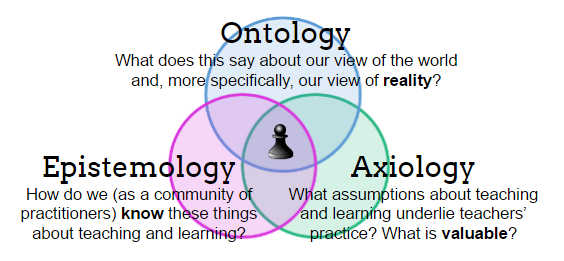
Ontology, Axiology and Epistemology
Ontology, axiology and epistemology are important related concepts in philosophy.

Ontology originally referred to the branch of metaphysics dealing with the nature of being and reality. In short, ontology refers to our ideas of reality and how it is constituted.

Epistemology, in turn, is interested in how we can acquire knowledge about that reality. The Greek word, ‘episteme’, refers to knowledge. Epistemologists try to identify the essential, defining components of knowledge. Thus, both of these provide a basis for learning and teaching, and they appear in learning theories. Equally, what we understand by learning and teaching leads to ontological and epistemological assumptions.

In addition to ontology and epistemology, there is a third concept of axiology that relates to value theories. It considers the values related to both ontology and epistemology. In its broad sense in the context of ontology, it addresses questions such as what is considered valuable in our world and our existence in it. The ideas educational systems adopt reflect what society regards as valuable for its success and welfare. (Audi, 1995)

Kent Lofgren's video "What is epistemology? Introduction to the word and the concept", which we view in class, defines epistemology as the study of knowledge, and contrasts empiricism (based on experience and observation) and rationalism (based on reason and logic). He also compares formal, genetic and social epistemology.

Of course 'Western' views of epistemology are not the only perspectives. “While Western science and education tend to emphasise compartmentalized knowledge which is often de-contextualized and taught in the detached setting of a classroom or laboratory, indigenous people have traditionally acquired their knowledge through direct experience in the natural world. For them, the particulars come to be understood in relation to the whole, and the ‘laws’ are continually tested in the context of everyday survival.” (Barnhardt & Kawagley, 2005).


Philosophy of Education
If you want, you can read http://plato.stanford.edu/entries/education-philosophy/ and reflect on your own teaching practice and personal views on the Philosophy of Education and Knowledge.

Purpose of Education
Gert Biesta helps us to a wider view of education by focusing on the question of purpose – putting the ‘why’ of education before the ‘how’. He suggests these three broad domains of educational purpose:


The purpose of Maori education
In February 2001 the first Hui Taumata Mātauranga provided a framework for considering Māori aspirations for education. It resulted in 107 recommendations based around the family, Māori language and custom, quality in education, Māori participation in the education sector and the purpose of education. There was also wide agreement about three goals for Māori education:
to live as Māori
to actively participate as citizens of the world
to enjoy good health and a high standard of living

7 Skills students need for their futureDr. Tony Wagner, co-director of Harvard's Change Leadership Group has identified what he calls a "global achievement gap," which is the leap between what even our best schools are teaching, and the must-have skills of the future: * Critical thinking and problem-solving * Collaboration across networks and leading by influence * Agility and adaptability * Initiative and entrepreneurialism * Effective oral and written communication * Accessing and analyzing information * Curiosity and imagination