Showing posts with label digital. Show all posts

Friday, March 24, 2017

Assignment 2 Digital and collaborative learning

30% Explain your implementation of a digital and collaborative learning innovation that addressed an identified area for improvement in your practice
20% Document your evidence for the impact of your innovation using methods appropriate to the context (for example student feedback, student work, observations, results, etc.)
30% Critique the successes and failures of your innovation and how you might have done things differently
10% Use and present suitably cited and referenced source material in APA format, including peer reviewed journals
10% Deliver and present content effectively, considering structure, narrative and presence. Include reflection on your learning.

EXPLAIN YOUR INNOVATION: You have described the implementation of your digital and collaborative innovation.
EVIDENCE OF IMPACT: You have documented more than one source of evidence for the impact of your innovation and they are related to one another.
CRITIQUE SUCCESS AND FAILURE: You have analysed successes and/or failures, with direct reference to different options.
USE AND PRESENT SOURCE MATERIAL: You have provided a good list of references, which are cited and discussed.
DELIVER AND PRESENT REFLECTIVE CONTENT: Your presentation describes and combines themes, with a narrative structure that reports on what has been learned.
FEEDBACK/FORWARD: Thanks for sharing your work on collaboration in your classroom. Collaboration permeates everything your students have done, right from the think, pair, share to the co-constructed rubric. The different ideas and tools you have used is very impressive teaching, you have given me ideas that I will use in future work. You may be a little disappointed that your grade here may not match the teaching. Your assignment does move away from the higher level of the TML rubric. For example, you seemed to have selected collaboration through personal choice rather than linking it to a problem in your practice. You also need to evaluate possible solutions to the problems you faced. Looking forward, you need to focus on the demands of the TML assessment rubrics, thinking what would this look like in relation to your initiative. In this case, it seems your focus you have allowed too much time to describe your initiative, leaving less to investigate its impacts in depth. Video
70%


Week 15 - Gamification

Gamification
Gamification is a concept, which is not exclusive of education. Some researchers generically defined it as “the use of game design elements and game mechanics in non-game contexts” This broad definition has been further refined to reflect the most common objective of gamification: increase user experience and engagement with a system. It is important to note that Games and Gamification are two different things! (Deterding, Dixon, Khaled & Nacke, 2011).
Gamified Services
Huotari & Hamari (2011) outline some ways in which services have been gamified

Core serviceEnhancing serviceGamified service
  • LinkedInprofile
  • Progress bar measuring progress in filling personal details
  • The enhancing service increases the perceived value of filling all details by invoking progress-related psychological biases.
  • Cafe
  • Mayorship competition in Foursquare  
  • The enhancing service creates a competition between customers where they have to visit the cafe frequently enough → competition
  • Dry cleaner
  • Loyalty stamp card - 1 stamp for every visit
  • The enhancing service invokes the psychological biases related to progress and thus increases the perceived value of using the same dry cleaner service.
  • Gym
  • Heya Heya
  • Gym experience that sets goals and help to monitor the progress of the training.

Game mechanics
In his video (on the portal) Seth Priebatsch described the four game mechanics of appointment, influence and status, progression and communal discovery. Badgeville (n.d.) outline a large number of game mechanics:

  • Achievements 
  • Appointments 
  • Behavioral Momentum 
  • Blissful Productivity 
  • Bonuses 
  • Cascading Information Theory 
  • Combos 
  • Community Collaboration  
  • Countdown 
  • Discovery 
  • Epic Meaning 
  • Free Lunch 
  • Infinite Gameplay         
  • Levels 
  • Loss Aversion 
  • Lottery  
  • Ownership 
  • Points 
  • Progression 
  • Quests 
  • Reward Schedules         
  • Status 
  • Urgent Optimism 
  • Virality 


Professional leadership games
Gamification has been applied to leadership in some organisations One example is the NTT Data Ignite Leadership Game that addresses five key skills for leaders
negotiation
communication
time management
change management
problem solving


Deloitte's Leadership Learning Motivator includes sharing badges on professional networks such as LinkedIn and Twitter. Meister (2013) provides some more detail on both games, while Bodnar (2014) explores some of the key concepts in more depth, including some discussion around whether the same motivational game mechanics work across cultures.
Seven principles of game-based design
These principles are outlined on the Quest to Learn website (Quest To Learn, n.d.)
Everyone is a participant
Challenge
Learning happens by doing
Feedback is immediate and ongoing
Failure is reframed as “iteration”
Everything is interconnected
It kind of feels like play


Game thinking
Marczewski (2016) explores the following types of game thinking:
Game inspired design: This is where no actual elements from games are used, just ideas such as user interfaces that mimic those from games, design or artwork that is inspired by games or the way things are written.
Gamification: Extrinsic gamification is the sort that most people are used to, where game elements are added to a system. Things like points, badges, progress bars etc.Intrinsic gamification is more about using motivation and behavioural design to engage users.
Serious games: These may be teaching/learning games that teach you something using real gameplay, simulators that provide a virtual version of something from the real world that allows safe practice and testing, meaningful games that use gameplay to promote a meaningful message to the player, or purposeful games that create direct real world outcomes.
Play (games / toys): Play is free form and has no extrinsically imposed goals. It is done for fun or joy. Games add defined goals and rules to play (such as challenges). Toys are objects that can be used in play or games.
Some examples of serious games
Sparx (https://www.youtube.com/watch?v=9pfzCKt0FyA )
Quest2teach (http://quest2teach.strikingly.com/ ).
Tinnitus game (http://www.uniservices.co.nz/Portals/0/All%20One%20Pagers/Tinnitus_game.pdf)
Cancer Research UK's game Play to Cure: Genes in Space (http://scienceblog.cancerresearchuk.org/2014/02/04/download-our-revolutionary-mobile-game-to-help-speed-up-cancer-research/)
Educational game model
According to Amory (2007), Educational computer games should:
Be relevant, explorative, emotive and engaging
Include complex challenges, puzzles or quests
Be gender-inclusive and non-confrontational
Provide appropriate role models
Develop democracy and social capital through dialogue
Support authentic learning activities
Support the construction of tacit knowledge


Educational games need all the usual qualities of games, plus they should not contain any socially undesirable features (racism. sexism, violence, etc) but provide positive models, plus they have to have some embedded pedagogy. Maybe this explains why successful educational games are so hard to create.
Kupu Hono
You can try out a basic demo of Tyne Crow’s Kupu Hono Maori language learning game at www.kupuhono.co.nz
This is an example of a learning game designed for mobile devices that uses a virtual game world.
Flow theory
Flow experience is widely accepted to be one of the fundamental reasons that people play games. It is the essence of games. For game designers, the question is not whether flow is important, but, rather, how long you can keep your players in flow (Murphy, 2011).
Game creation tools
One of the tools that could be used with students to create their own games is Gamefroot. There is a video in the portal about how one teacher used Gamefroot for assessment.
Mobile Learning Tools
A number of tools have been developed for mobile devices that support game-like learning experiences linked to exploring outdoor environments. They include such features as competing individuals / teams, ‘treasure hunt’ style activities, scores/ badges for achievement and leader boards. Some examples of this type of tool include:
Seppo
Wikitude
ARIS
ActionBound
Layar 


Week 14 - Digital Design Thinking in the Classroom

Change by DesignTim Brown, CEO of IDEO, has written the book about Change by Design (2009). According to him Design Thinking is Human-centered: ‘The basic problem is that people are so ingenious at adapting to inconvenient situations that they are often not even aware that they are doing so. Our real goal is helping people to articulate the latent needs they may not even know they have’.
Observation is important too: ´When we observe people going about their daily lives, what is it that they don’t do or don’t say?´ as well as empathy, or as Brown calls it: 'Standing in the shoes of others'. Brown talks a lot about the importance of prototyping, because:‘Like every other kid, I was thinking with my hands…’. If you want to hear him talking about his book, we recommend you listening to this radio show.
Teaching Practices that encourage Design ThinkingImmersion:Have students work together in small collaborative groups to do a deep dive into the subject/topic area. Ask the students to undertake research, observation and develop questionnaires or evaluate data to gain a technical, personal and community views on a topic.
Inquiry-based Feedback:Instead of value-based feedback, inquiry based feedback coupled with observation encourages a more open-ended and in-depth approach to learning. Students are encouraged to minimise expressing their likes and dislikes, and encouraged to first spend time silently observing, and then asking questions prefixed by phrases such as "I noticed that...," "why," and "how."
Before this process begins ensure students brainstorm ways to gather information. For example:
Research that includes eBooks, case studies, experiments, data, academic papers etc
Observation that includes personal viewing, filming, online videos, documentaries, recorded interviews
Questionnaires that includes personal questionnaires, online surveys, research and data including census, government agency information, non-government organisation data, OECD reports etc.
Synthesis:
Have students deduce interesting gaps to explore, problems to solve or opportunities to solve, using the information they have gathered from their immersion process.
Ideas on how to gain a new perspective
Put visuals on the wall which relate to the topic but at the fringes of the core subject.
Ask new questions. Create a how, when, why, what, who question and define the answers.
Note: Ask "thinking" questions – don’t make suggestions. Instead of asking questions to which there is a correct answer, ask students to create the problem. For example instead of saying"Does your girl need ears?" A thinking question would be, "What kind of music does your girl like to listen to? How can she hear the music?"
Students should pose their problem by first tapping into their own wishes and goals that might have real-life results or be largely theoretical and in end in the modeling stages. Such questions such as "How can we grow vegetables without using pesticides?" And, "How can we feed the world's population in a sustainable way?" Both encourage students to think divergently.
Questions, not suggestions, allow personal ownership based on observing, on experiences and on the imagination.
Zoom out:Put the subject/topic in the centre of focus and scale out to the next logical layer. For example if the topic was endangered tigers of India, scale back and look at the life of poachers, the local communities, the black market skin/medicine customers etc. Explore each logical layer of influence as you scale back from the heart of the topic to develop a macro view of the subject.
Ideation, Prototyping and Feedback:Have your students test ideas, solve a problem and extend their understanding without focusing on the ‘right’ answer. This part of the Design Thinking process
helps student to 'hold their ideas lightly' in order to review and gain feedback from other student groups and their teacher/s.
The emphasis is on thinking skills and mindsets that allow students to create early and often, adjusting the course of their learning and applying an iterative approach to outcomes that is tweaked from the input of feedback.
Note: Nurture a culture of divergent thinking. Encourage students to be choice makers. Ask students ‘what their work needs’. If a student asks for help, assist by asking the child to give several of their ideas to discuss..
Implementation or Display:As ideas and defined the Design Thinking process moves to the celebration stage where concepts are shared. In this stage have students talk to the group about the changes they applied in their approach, what they reflected on, what evidence they found to support their findings and what new knowledge they gained or shared.


Week 13 - Inquiry Learning and Teacher Inquiry

Teacher Inquiry into Student LearningThis week, in this course we are covering Teacher Inquiry into Student Learning, and in the digital and collaborative course we are covering inquiry learning. Team Solutions (2009) make the distinction between them as follows:
Inquiry Learning (DIGITAL)
Teacher Inquiry (LEADERSHIP)
A process where students co-construct their learning in an authentic context
Where teachers inquire into their own practice and use evidence to make decisions about ways to change that practice for the benefit of the student
Critical InquiryIn the Practising Teacher Criteria (Professional Knowledge in Practice), critical inquiry is part of the criteria (Education Council (n.d.)
Criterion 12 is "use critical inquiry and problem-solving effectively in their professional practice"
The key indicators are:
systematically and critically engage with evidence and professional literature to reflect on and refine practice
respond professionally to feedback from members of their learning community
critically examine their own beliefs, including cultural beliefs, and how they impact on their professional practice and the achievement of ākonga
Further details can be found on the Education Council Website.

Teaching as InquiryThe NZ Ministry of Education also has a series of web pages explaining what they define as Teaching as Inquiry
The Spiral of Inquiry

This is described on the MoE's TKI website as “a fresh rethink on the structure of teaching as inquiry.” (Ministry of Education, 2015). It emphasises involvement of learners, their families and communities and developing learner agency. It states that engaging in inquiry is a process of developing collective professional agency either within a school or across a cluster of schools. The approach is described in Timperley, Kaser & Halbert (2014). They emphasise agency and collaboration: "Engaging in inquiry is a process of developing collective professional agency either within a school or across a cluster of schools”, and “Nor can leaders decide what the focus of their inquiry should be. It is the collaborative inquiry process that matters”
A number of teachers use this approach rather than the Teaching as Inquiry cycle, described in more detail on the Ministry web site.

Spiral Playbook


Thursday, March 23, 2017

Week 12 -Innovative Learning Spaces / Maker Movement


Innovative classrooms reflect new ways of teaching and learning and they remove the focus from a teacher led environment to a space where teachers and learners collaborate.

These learning environments are much more creative, flexible and supportive of technology and are ideally designed to facilitate a more creative approach to content, and new ways to deliver the curriculum that encourages connections in content, encourages excitement and makes learning a transformational experience.

Our classrooms should support new ways of accomplishing the desired outcome that is more active and enables students to retain knowledge and expand on concepts beyond what is taught in the classroom.

Modern learning spaces should be bold and encourage risk taking and original thought through breaking rules around what a classroom should look like.


Week 11 Agile and Servant Leadership/ Lean education

Agility means the capability of rapidly and efficiently adapting to changes.
Agile leadership It is the art of being flexible under the influence of rapidly changing external conditions. It means being flexible, responsive to change, and willing to learn and adopt new ways, leading to effectively survive and succeed in the complex modern competitive business environment."It is not the strongest or the most intelligent who will survive but those who can best manage change." - Charles Darwin.
Agile Leadership Style
Agile leadership is situational, adaptive, empowering and inspirational. The most important leadership theory applied to agile is that of servant leadership (Highsmith, 2009).“For the Agile Leader, servanthood is the strategy. Situational actions are the tactic” (Filho, 2011).The key characteristics of the servant leader include awareness, listening, persuasion, empathy, healing, and coaching. Situational leadership means that the servant leader may act as a democratic leader, a laissez-faire leader, or an autocratic leader in different situations (Koganti, 2014).
Servant Leadership
The originator of the servant leadership concept (though inspired by a Herman Hesse story) was Robert Greenleaf. “The best test, and difficult to administer, is: Do those served grow as persons? Do they, while being served, become healthier, wiser, freer, more autonomous, more likely themselves to become servants? And, what is the effect on the least privileged in society? Will they benefit or at least not be further deprived?” (Greenleaf, 1970
Teachers as Servant Leaders
Servant leadership has been applied by a number of authors to teaching. “The teacher as servant leader functions as a trailblazer for those served by removing obstacles that stand in their path. Part of unleashing another’s talents is helping individuals discover latent, unformed interests. Art, music, and science teachers are prime examples of educators whose genius lies in leading students to discover unarticulated interests.” (Bowman, 2005),


Agile methods
The Agile movement proposes alternatives to traditional project management. Agile approaches, such as Scrum and eXtreme programming were designed for the software development to help businesses respond to unpredictability. Aspects of Lean production (from the Toyota Production System) are also increasingly utilised by agile practitioners, for example Kanban boards, where limiting the number of current work items elegant workflow. Kanban's 'pull' model makes the flow of work visible across the team. In software development, 'Scrumban' is a populate fusion of Scrum and Kanban.
Nowadays Agile and lean practices are used in industries outside of manufacturing and software development. Agile is recognized more generally now as simply a great way of getting things done in rapidly changing and highly unpredictable situations.
Agile and Lean Ideas in Learning
In this week's classes we ponder what Agile and Lean methods can offer to the education sector. Even though Agile was developed within the software industry, the bridge is that it is fundamentally about learning, people, and change - three things we struggle with in education. Many are amazed at how easily Agile and lean ideas translate into education, and how perfectly-suited they are, for example, to running schools.

Week 7 - Blended Learning

Blended Learning
The definition of blended learning is a formal education program in which a student learns: (1) at least in part through online learning, with some element of student control over time, place, path, and/or pace; (2) at least in part in a supervised brick-and-mortar location away from home; (3) and the modalities along each student’s learning path within a course or subject are connected to provide an integrated learning experience.

Blended Models (see http://tinyurl.com/tmlblended)
These blended learning models come from the Clayton Christensen Institute
Rotation model
Station Rotation
Lab Rotation
Flipped Classroom
Individual Rotation
Flex model
A La Carte model
Enriched Virtual model

Flipped Classroom
The idea of the flipped classroom as first developed in 2007 by Bergmann & Sams (2012), who describe their experience in their book "Flip Your Classroom: Reach Every Student in Every Class Every Day". The idea behind a flipped model of education is that much of the content is covered outside of the classroom through bite sized (under 10 minute) video clips, quizzes and collaborative discussions. Subsequently deeper learning can occur in the classroom through face to face discussion which can apply, evaluate and contextualise the content as well as enhancing collaborative activities, strengthening relationships, developing communication skills and other key competencies. The pedagogical approach has to be adapted and the mode of teaching must change to a more student orientated practice as the content (often teacher led) part of the session has already been covered. A flipped method fits in extremely well with many different learning areas but particularly links well and supports active learning experiences; more time for hands on learning and less time stuck in the classroom.

One interesting approach suggested by Schell (2013) is that it is best not to t tell students you are “flipping” or “experimenting” since they might be resistant to the idea. Instead, just go ahead and do it (stealth flip'). She also suggests that just flipping the classroom is not enough; you probably also need to rethink your assessment practice.

In-Class Flipping (See http://tinyurl.com/tmlflip)
Besides the fact that it avoids the home-related problems of a traditional flip, the In-Class Flip has other advantages as well:
The teacher can observe whether students are really watching.
The initial exposure to the video content has a better chance to sink in.
Hardware is (presumably) safer.
In-Class Flipping is not without its own challenges:
It doesn't make for tidy one-period lesson plans.
More preparation is required at the beginning. .
Technically, you don’t "gain" more class time.

Tools for Creating Content for Flipped or Blended LessonsEdPuzzle
A simple tool to add content to existing videos. Can use video content from multiple sources within the site, or upload your own video. It’s also easy to “crop” videos so you are only showing the section of the video you want students to watch instead of the whole thing. Insert questions anywhere in the video you want and have multiple choice questions automatically graded. Teacher view shows you which students have watched the video and how they fared on the questions. https://edpuzzle.com/

TED-Ed
TED-Ed is TED’s youth and education initiative. Using any video on TED-Ed, TED Talks or YouTube, teachers can create and customize lessons for their students. There are four elements, Watch, Think, (teachers can create multiple choice or short answer questions), Dig Deeper, (provide more information), and Discuss (prompts for online discussions). http://ed.ted.com/lessons

BlendSpace
Blendspace is an easy-to-use platform for creating multimedia lessons that can be accessed online. Using a drag-and-drop interface, can organize videos, text, links, images, and quizzes into cubes, then organize them to create lessons, or "canvases, " for your students to complete independently. https://www.tes.com/lessons

Week 6 - Leadership Theories and Styles and connected learning

Connected learning
If “Connected learning is about much more than plugging youth into technology.” Then what is connected learning?

Due to the rapid change and technological advancement, the demands and opportunities placed on our students are greater than ever. Constantly changing networks (personal, social, and work) challenge students to process, learn, and respond to torrents of new information and new technologies. Learning is no longer framed by restrictions of time and place. Knowledge is now available everywhere, 24 hours a day so new models of education need to recognise learning as a constant with delivery modes and learning times as the variables.
New education models are needed to expand learning beyond the school through connected networks that bring education opportunities together into a seamless, integrated experience. In 2016 there is no reason why the abundance of resources and knowledge on the internet should be contained within a physical classroom, and there is little reason why a student should be confined to only taking courses offered by their school.
The notion of ensuring interchange and integration of learning networks and of the resources should underpin the construction of new education models. Connected learning and connectivism are two complementary views of the power of the network in 21st century learning

Leadership Theories
As time has progressed a number of leadership theories have emerged which deal with various styles and methodologies about leadership. These theories could be labelled in four broad headings; namely the Trait theories, Behavioral theories, Contingency theories and the Power and Influence theories. In 1922, Max Weber (see Weber, 1978) identified three kinds of leader/follower relations; traditional, bureaucratic and charismatic. He also noted that they occur in combination, and there may be gradual transitions between these types. Since then, much has been written about types of leadership. Some examples of leadership theories relevant to education include
Servant Leadership
Pedagogical Leadership
Transactional Leadership
Transformational Leadership
Maori Leadership

Burns (1978) outlined the original ideas for both transactional and transformational leadership. He stated that both are 'moral' forms of leadership, as opposed to 'amoral' power-wielding.

Bass & Riggio (2006) developed their transformational leadership theory based on Burns' original ideas. This has been the one many of our students have found interesting to reflect upon in their Leadership 1 assessments. According to this theory, transformational leadership can be defined based on the impact that it has on followers.

Providing a different perspective, Tū Rangatira: Māori Medium Educational Leadership (Ministry of Education, 2010) presents a model of leadership that reflects some of the key leadership roles and practices that contribute to high-quality educational outcomes for Māori learners. It focuses on leadership practices, providing insights into how effective professional development programmes can work towards strengthening leaders’ capabilities, growing capacity and sustaining exemplary leadership in the Māori medium education sector.

Leadership StylesDuring this week's lesson we'll also introduce some views on different leadership styles. Keep in mind that the styles are often drawn from the theories, so from your assessment point of view get your justifications from the theories and link them to the styles you used.

Complete the University of Kent online quiz about your typical leadership styles When you have finished record your results and thoughts for later use (Leadership 1 & 2 Assessments).

Based on a three-year study of over 3,000 executives, Goleman, Boyatzis & McKee (2013) identified six different leadership styles
Pace-setting leaders expect excellence and self-direction, and can be summed up as ‘Do as I do, now’. The Pace-setter very much leads by example, but this type of leadership only works with a highly-competent and well-motivated team.
Authoritative leaders move people towards a vision, so are often described as ‘Visionary’. This style is probably best summed up as ‘Come with me’. It is the most useful style when a new vision or clear direction is needed, and is most strongly positive.
An Affiliative leader values and creates emotional bonds and harmony, believing that ‘People come first’. Such leaders demonstrate empathy, and strong communication skills, and are very good at building relationships. This style is most useful when a team has been through a difficult experience, and needs to heal rifts, or develop motivation.
The democratic leader builds consensus through participation, constantly asking ‘What do you think?’, and showing high levels of collaboration, team leadership and strong communication skills. This style of leadership works well in developing ownership for a project, but it can make for slow progress towards goals, until a certain amount of momentum has built up.
A coaching leader will develop people, allowing them to try different approaches in an open way. The phrase that sums up this style is ‘Try it’, and this leader shows high levels of empathy, self-awareness and skills in developing others. A coaching style is especially useful when an organisation values long-term staff development
Coercive leaders demand immediate obedience. In a single phrase, this style is ‘Do what I tell you’. These leaders show initiative, self-control, and drive to succeed. There is, of course, a time and a place for such leadership: a battlefield is the classic example, but any crisis will need clear, calm, commanding leadership. 

Leadership Attributes
There are many personal characteristics that may be identified as aspects of leadership. However it may be helpful to explore some of the attributes identified within various categories that we have introduced on the course previously. These include:
Key Competencies (e.g. relating to others)
21st Century Skills (e.g. real-world problem-solving and innovation)
Growth Mindset (e.g. resilience)
Adaptive Competence (e.g cultural awareness)
Emotional intelligence (e.g. social skill)
World Economic Forum (2015) character qualities (e.g. initiative)

Thursday, December 8, 2016

Week 5 - Digital Collaboration Computational Thinking

Reflection:Reflect how and why would you use Computational Thinking in your classroom?
Computational thinking is all about solving problems and would be excellent when teaching coding. Students need to think about how computers actually work and why things work like they do. This fits into geometry extremely well as alot of the computational thinking aligns with direction and position. I would include computational thinking as part of my problem solving in maths.

Notes:
Computational Thinking

Computational Thinking is a problem solving process. It is a fundamental skill for everyone, and involves solving problems, designing solutions and systems to solve open ended problems based on multiple variables. We illustrate the concept in this week's session with the following quotes:

“Everyone should learn how to program a computer, because it teaches you how to think.” (Steve Jobs, cited in Sen, 1995)

"Computational thinking is a way humans solve problems; it is not trying to get humans to think like computers." (Wing, 2006)

“The impact of computing extends far beyond science, however, affecting all aspects of our lives. To flourish in today's world, everyone needs computational thinking.” (Carnegie Mellon University, n.d.)

Computational Thinking Means... Solving problems
Applying abstraction and decomposition
Thinking algorithmically - what’s the process?
Thinking conceptually - what’s the model?
Understanding how things repeat and scale
Dealing with errors
...among other things (depends who you read)

Pair Programming
Pair programming is a common technique in agile software development. One member of the pair is the ‘driver’ (does the typing, and focuses on tactics) while the other is the ‘navigator’ (can review and suggest, and focuses on strategy). When pair programming you should change your roles within the pair on a regular basis, and also change your partner on a regular basis.

Week 3 - Digital Collaboration Virtual and Augmented reality

Reflection: Consider ways that you may be able to use Virtual or Augmented Reality in your classroom or school? What would it add? How would it change the learning?
Augmented and virtual reality seems like a highly motivated way to get children hooked into their learning. The first of these is when they do their self portraits at the beginning of the year they can use Aurasma to include a video about themselves as well. Also when researching a topic they can go on a virtual tour of the place they are studying without actually going there.

Notes: To thrive in today’s innovation-driven economy, workers need a different mix of skills than in the past. In addition to foundational skills like literacy and numeracy, they need competencies like collaboration, creativity and problem-solving, and character qualities like persistence, curiosity and initiative.

Numerous innovations in the education technology space are beginning to show potential in improving education and helping address skills gaps. To help lower the cost and improve the quality of education,education technology is being used to:
• Find creative solutions to fundamental challenges in many countries, such as a lack of well-trained teachers and broadly accessible technology infrastructure
• Make education available to a broader audience at a much lower cost or provide higher quality instruction at the same price
• Enable easier scaling up of promising models within local markets and the transfer of best practices across markets in ways that can be sustained over the long term
• Gain insight into how and what students learn in real time by taking advantage of the greater variety, volume and velocity of data
• Increase teacher productivity, freeing up valuable time from tasks such as grading and testing,which can be used for differentiated teaching of competencies and character qualities

but when educators add education technology to the mix of potential solutions, we find they are most effective if applied within an integrated instructional system known as the closed loop. As in engineering or manufacturing, the closed loop refers to a system that requires an integrated and connected set of steps to produce results. In the educational world,the closed-loop instructional system works similarly.At the classroom level of the closed loop, educators create learning objectives, develop curricula and instructional strategies, deliver instruction, embed ongoing assessments, provide appropriate interventions based on student needs and track outcomes and learning. All these efforts must be linked together as well as aligned with the goal of developing 21st-century skills.

When education technologies are layered throughout the closed loop, we argue that technology-based solutions such as the sample profiled here have the potential to enable teachers, schools, school networks and countries to scale up solutions in ways not possible before and potentially to deliver better outcomes and learning.

Increasingly, best-in-class curricula aim to teach multiple skills at the same time. For example, teachers might use word problems to teach multiplication,directing students to think critically and solve problems while developing both literacy and numeracy skills.Education technology has the potential to become an option for teachers in delivering this combination of foundational literacies, competencies and character qualities.

Disruptive Technologies
"Disruptive technologies typically demonstrate a rapid rate of change in capabilities in terms of price / performance relative to substitutes and alternative approaches, or they experience breakthroughs that drive accelerated rates of change” (Manyika, et al. 2013).

"The more overdue a disruption is, the more sudden it is when it finally occurs, and the more off-guard the incumbents are caught"...“eliminating the bottom 99% of workers in [the teaching] professions” (Gade, 2014)

One of the world's largest...
...taxi companies owns no taxis (Uber)
...accommodation providers owns no real estate (AirBnB)
...phone companies owns no telecom infrastructure (Skype)
...retailers has no inventory (Alibaba)
...movie houses owns no cinemas or physical stores (Netflix)
...media companies owns no content (Facebook)
...software vendors doesn’t write the apps (Apple / Google)


Which careers are a safe bet?In 2015 the BBC set up a web page entitled "Will a robot take your job?" http://tinyurl.com/willarobottakeyourjob

WHAT THE EXPERTS THINK ABOUT JOB CREATION AND DESTRUCTION [Excerpt from the PDF document online]
The speed of technological and social change is increasing. This raises the divisive question: could the costs of change outweigh the benefits for extended periods? In a 2014 survey of 1,896 experts conducted in the US, around half envision a future where robots and digital agents displace significant numbers of blue and white collar jobs. The other half expect that technology will create more jobs than it displaces. The survey identified key themes with reasons to be hopeful and reasons to be concerned:

REASONS TO BE HOPEFUL
• While advances in technology may displace certain types of jobs, historically they have also resulted in net job increases
We adapt to changes by inventing entirely new types of work, and by taking advantage of uniquely human capabilities • Technology will continue to free us from day-to-day drudgery, and allow us to define our relationship with ‘work’ in a more positive and socially beneficial way
• Ultimately, as a society we control our own destiny through the choices we make.

REASONS TO BE CONCERNEDSo far automation has impacted most on blue-collar employment. However, the coming wave of innovation threatens to upend white-collar work as well • Certain highly skilled workers will prosper in this new environment but far more may be displaced into lower paying service industry jobs at best, or permanent unemployment at worst
Many educational systems may not be adequately preparing us for the work of the future, and some political and economic institutions appear to be poorly equipped to adjust.

The Reality ContinuumFrom Milgram, Takemura, Utsumi & Kishino (1994). Between the two extremes of the real environment and a completely virtual one, the continuum goes from overlaying reality with a few additional elements on the left, to the occasional introduction of real elements into a digital environment (e.g. the user’s hand) on the right

Virtual Reality Creates immersive, computer generated environments which replaces the real world
The user is completely immersed in an artificial world and cut off from the real world
Senses are mediated by the virtual world
Popular VR headsets include Oculus Rift and Google Cardboard. Google Expeditions, which you can use with Cardboard, is a virtual reality teaching tool that lets you lead or join immersive virtual trips all over the world — get up close with historical landmarks, dive underwater with sharks, even visit outer space! It was released free to the public on 27 June 2016 but is not totally free, especially for the whole class and with full features. Google Tilt Brush is another recent VR application that supports the creation of 3D virtual art..
Augmented Reality Closer to the real world
Adds graphics, sounds and smells to the natural world as it exists
User can interact with the real world, and at the same time can see both, the real and the virtual co-existing
User is not cut off from reality
Sense of presence in real world is maintained

Gada, K. (2014). The Education Disruption : 2015, Retrieved from http://www.singularity2050.com/2014/07/the-educati...Manyika, M. et al. (2013). Disruptive technologies: Advances that will transform life, business, and the global economy. McKinsey & Company.Milgram, P., Takemura, H., Utsumi,A. & Kishino, F. (1994). Augmented Reality: A class of displays on the reality-virtuality continuum. In Proceedings SPIE 2351, 282-292.

Week 4 - Digital Collaboration Learning Theories

Notes:

Top Ten Learning Theories for Digital and Collaborative learning 2015


Dr David Parsons, National Postgraduate Director, The Mindlab by Unitec, Auckland, New Zealand


Instrumental conditioning Burrhus Skinner (1904 - 1990)
Behaviour leads to reinforcement
needs rapid feedback and work at own pace
Positive Reinforcement

Connectionism Edward Thorndike (1874 - 1949)
Law of effect: reinforcement increases the strength of a connection, punishment does not change it.

Progressive Education John Dewey (1859 - 1952)Co-operation between school and home
Hands on learning
" Give the pupils something to do, not something to learn; and the doing this is of such a nature as to demand thinking; learning naturally results."

Constructivism - social development Lev Vygotsky (1896 - 1934)social learning precedes development
"the teacher must adopt the role of facilitator, not content provider"

Constructivism - Equilibration PiagetEducational environments should provide the opportunity for discovery by students.

Situated Cognition/Learning John Seely -Brown (1940) Allan Collins, Paul DuguidLearning is embedded in the activity, context and culture it was learned.
Learning while interacting with others through shared activities and language
Learning is about performance in situations rather than accumulation of knowledge.
"instead of pouring knowledge into people's heads, you need to help them grind anew a set of eyeglasses so they can see the world in a new way."

Community of Practice Jean Lave and Etienn Wenger (born 1950s)three components
1. domain
2. community
3. practice
Learning is unintentional and situated within authentic activity, context and culture
Learning based on social relationships; co-operation

Olsen, M.& Hergenhahn, B. (2013). An Introduction to Theories of Learning (9th ed.) Boston, Mass: Pearson


Constructionism in 21st Century classrooms (Video)A brief overview, by Margaret Pierciey, of constructionism, as outlined by Seymour Papert and Marina Bers. Covers the 4 basic subconcepts of:
Learning by designing within a community - initiate and design projects which are meaningful or useful to themselves or communities. Taking time to discuss along the way gives opportunities for new thinking. (debugging). Sharing what they have learnt and letting them inquire about what they need to know gives rise to an emergent curriculum. Interact and collaborative - peer mentors
Technological tools for learning
Powerful ideas and wonderful ideas- power of computers in the classroom lies in their potential to assist children in encountering powerful ideas and engaging them with experimenting and testing their ideas.
Learning about learning with technology - documenting and sharing the successes and achievements of a constructionists learning experiences are important 

Collaborative LearningCollaborative learning is a learning process that brings learners together (including the teacher) and enables students to be responsible for their own learning as well as the learning of their peers.
Collaborative learning is aimed at having students fully appreciate the process of building knowledge together and improving learning outcomes by collective knowledge and collective capability.


Dillenbourg (1999) identifies the difference between collaboration and cooperation as defined by a degree in the division of labour. In cooperation, partners split the work, solve sub-tasks individually and then assemble the partial results into the final output. In collaboration, partners do the work 'together' (Dillenbourg, 1999). Similarly, Kozar (2010) uses the analogy of a pot luck dinner where cooperation is defined as the guests bringing separate dishes to contribute to the meal, and collaboration as a messier chaotic process where guests cook together to create the meal, but gain new knowledge or experience from the interaction.

Dillenbourg P. (1999) What do you mean by collaborative learning?. In P. Dillenbourg (Ed) Collaborative-learning: Cognitive and Computational Approaches. Oxford: ElsevierKozar, O. (2010). Towards Better Group Work: Seeing the Difference between Cooperation and Collaboration.English Teaching Forum, 48(2), 16-23.

Learner at the Center of a Networked World
1. Learners need to be at the centre of new learning networks.
2. Every student should have access to learning networks.
3. Learning networks need to be interoperable.
4. All learners should have the literacies necessary to utilize media as well as safeguard themselves in the digital age.
5. Students should have safe and trusted environments for learning


Aspen Institute Task Force on Learning and the Internet, Learner at the Center of a Networked World, Washington, D.C.: The Aspen Institute, June 2014.


Saturday, November 19, 2016

Week 1 - Digital Collaboration Purpose of Education

Notes:
Epistemology and EducationFor generations we have pursued a "knowledge-based" curriculum that was developed at a time when access to information was scarce. Today’s digitally connected world offers unlimited, immediate and accurate information to nearly all the world’s questions. As answers to questions we already know provide little, if any, competitive advantage in today’s world it can be argued that education should now focus on stimulating and promoting the discovery of new possibilities.

An under-current of change driven by new teaching practices with proven success includes greater focus on functional skills, collaboration, creativity, understanding and evaluation of online data, social and cultural awareness, global connectedness and effective communication. This shift has seen acceptance of the sharing of learning outcomes and a move from ‘covering the curriculum’ to ‘discovering’ it.

‘The fact is that given the challenges we face, education doesn’t need to be reformed- it needs to be transformed. The key to this transformation is not to standardise education, but to personalize it, to build achievement on discovering the individual talents of each child, to put students in an environment where they want to learn and where they can naturally discover their true passions” (Robinson, 2009)


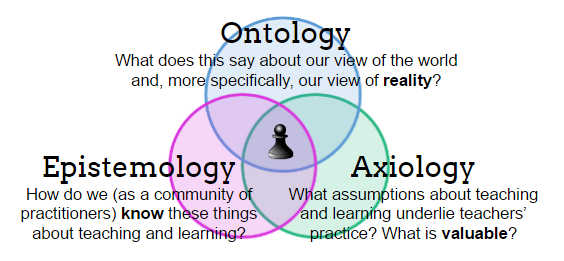
Ontology, Axiology and Epistemology
Ontology, axiology and epistemology are important related concepts in philosophy.

Ontology originally referred to the branch of metaphysics dealing with the nature of being and reality. In short, ontology refers to our ideas of reality and how it is constituted.

Epistemology, in turn, is interested in how we can acquire knowledge about that reality. The Greek word, ‘episteme’, refers to knowledge. Epistemologists try to identify the essential, defining components of knowledge. Thus, both of these provide a basis for learning and teaching, and they appear in learning theories. Equally, what we understand by learning and teaching leads to ontological and epistemological assumptions.

In addition to ontology and epistemology, there is a third concept of axiology that relates to value theories. It considers the values related to both ontology and epistemology. In its broad sense in the context of ontology, it addresses questions such as what is considered valuable in our world and our existence in it. The ideas educational systems adopt reflect what society regards as valuable for its success and welfare. (Audi, 1995)

Kent Lofgren's video "What is epistemology? Introduction to the word and the concept", which we view in class, defines epistemology as the study of knowledge, and contrasts empiricism (based on experience and observation) and rationalism (based on reason and logic). He also compares formal, genetic and social epistemology.

Of course 'Western' views of epistemology are not the only perspectives. “While Western science and education tend to emphasise compartmentalized knowledge which is often de-contextualized and taught in the detached setting of a classroom or laboratory, indigenous people have traditionally acquired their knowledge through direct experience in the natural world. For them, the particulars come to be understood in relation to the whole, and the ‘laws’ are continually tested in the context of everyday survival.” (Barnhardt & Kawagley, 2005).


Philosophy of Education
If you want, you can read http://plato.stanford.edu/entries/education-philosophy/ and reflect on your own teaching practice and personal views on the Philosophy of Education and Knowledge.

Purpose of Education
Gert Biesta helps us to a wider view of education by focusing on the question of purpose – putting the ‘why’ of education before the ‘how’. He suggests these three broad domains of educational purpose:


The purpose of Maori education
In February 2001 the first Hui Taumata Mātauranga provided a framework for considering Māori aspirations for education. It resulted in 107 recommendations based around the family, Māori language and custom, quality in education, Māori participation in the education sector and the purpose of education. There was also wide agreement about three goals for Māori education:
to live as Māori
to actively participate as citizens of the world
to enjoy good health and a high standard of living

7 Skills students need for their futureDr. Tony Wagner, co-director of Harvard's Change Leadership Group has identified what he calls a "global achievement gap," which is the leap between what even our best schools are teaching, and the must-have skills of the future: * Critical thinking and problem-solving * Collaboration across networks and leading by influence * Agility and adaptability * Initiative and entrepreneurialism * Effective oral and written communication * Accessing and analyzing information * Curiosity and imagination

Tuesday, November 15, 2016

Week 2 - Digital Collaboration 21st Century Skills

Reflection:Which 21st Century skills related area of your practice would you like to focus on in your Assessment 1? Why? Would your students agree? How do you know?
Collaboration
Knowledge construction
Self-regulation
The Use of ICT for learning
Skilled Communication
Real-world problem-solving and innovation

The key findings in the ITL Research were that innovative teaching supports students’ development of the skills that will help them thrive in future life and work. However, students’ opportunities to develop these skills are typically scarce and uneven, both within and across the sample of schools in the study.

The skill that I feel would help develop my practice and which I feel needs work on is Collaboration. Collaboration is encouraged in my classroom and children are often working on tasks together. However, I feel that they are more cooperating rather than collaborating as they do not have shared responsibility. When asking my students what they thought collaboration was, most of them thought it was just working together, helping each other or doing the same thing. A lot were not even able to tell me what collaboration was. This shows me that although I thought that we collaborated in the classroom, that in fact the children didn't know what we were doing and why we were doing it in that way. I need to construct a way of making the class more collaborative where activities require students to make decisions together and have shared responsibility.